
Energy management
Nan Pao continues to focus on low-carbon energy and process energy efficiency as the core of its energy management strategy. Through energy audits and management reviews at its operating sites to identify opportunities for improving energy performance, as well as the tracking of energy-saving projects, equipment replacement, and the adoption of renewable energy, the Company enhances energy efficiency and reduces operational carbon emissions. All plants at Nan Pao Taiwan headquarters, Foshan Nan Pao, and the Foshan Goosheng high-tech plant have obtained ISO 50001 energy management system certification, and the Company continues to strengthen energy management through three strategies: "automated energy management," "energy conservation and carbon reduction project promotion," and "management system optimization and energy conservation," with related performance incorporated into the incentive system.
Going forward, Nan Pao's expert team will continue to conduct plant health checks and provide guidance, proposing and helping implement improvements targeting energy use hotspots, and spreading energy-saving experience and improvement benefits through a "large plants leading small plants" approach to drive continuous improvement in overall energy efficiency. From 2025, non-renewable energy reduction performance has also been incorporated into the KPIs of senior managers, with specific reduction targets set as follows to strengthen management accountability and drive results.
| Content | Target Value |
|---|---|
| Non-Renewable Energy Consumption Intensity | 5% lower than in 2023 |
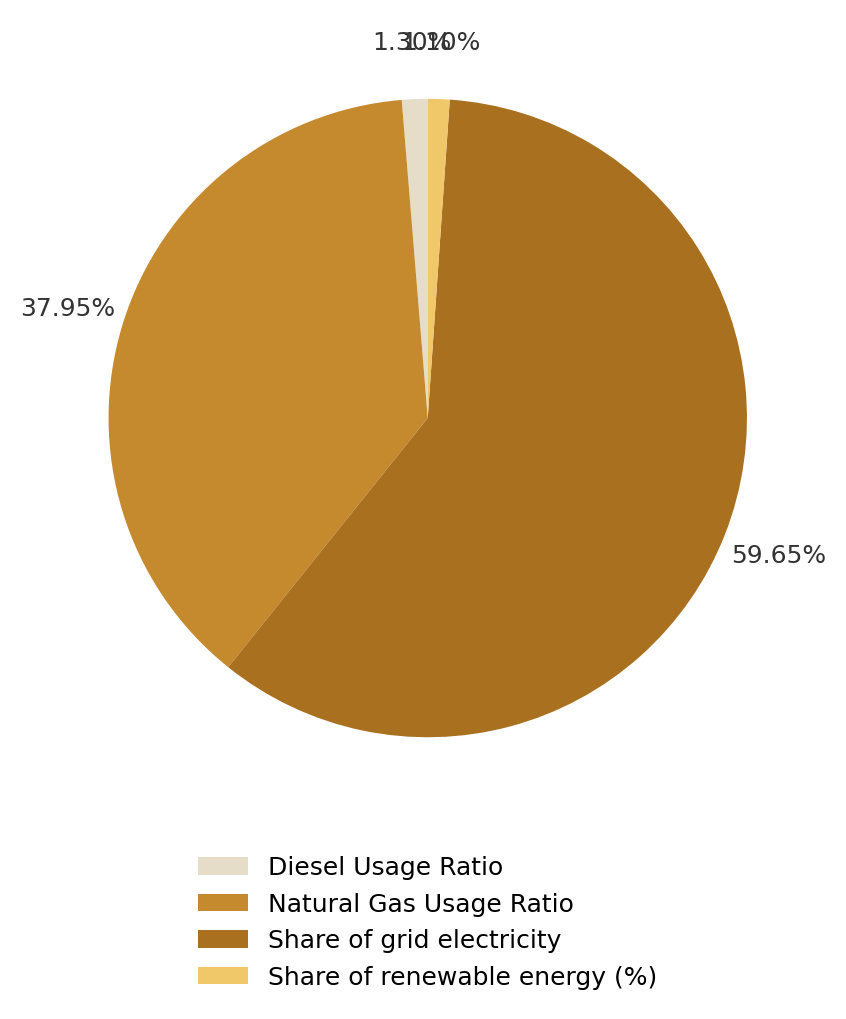
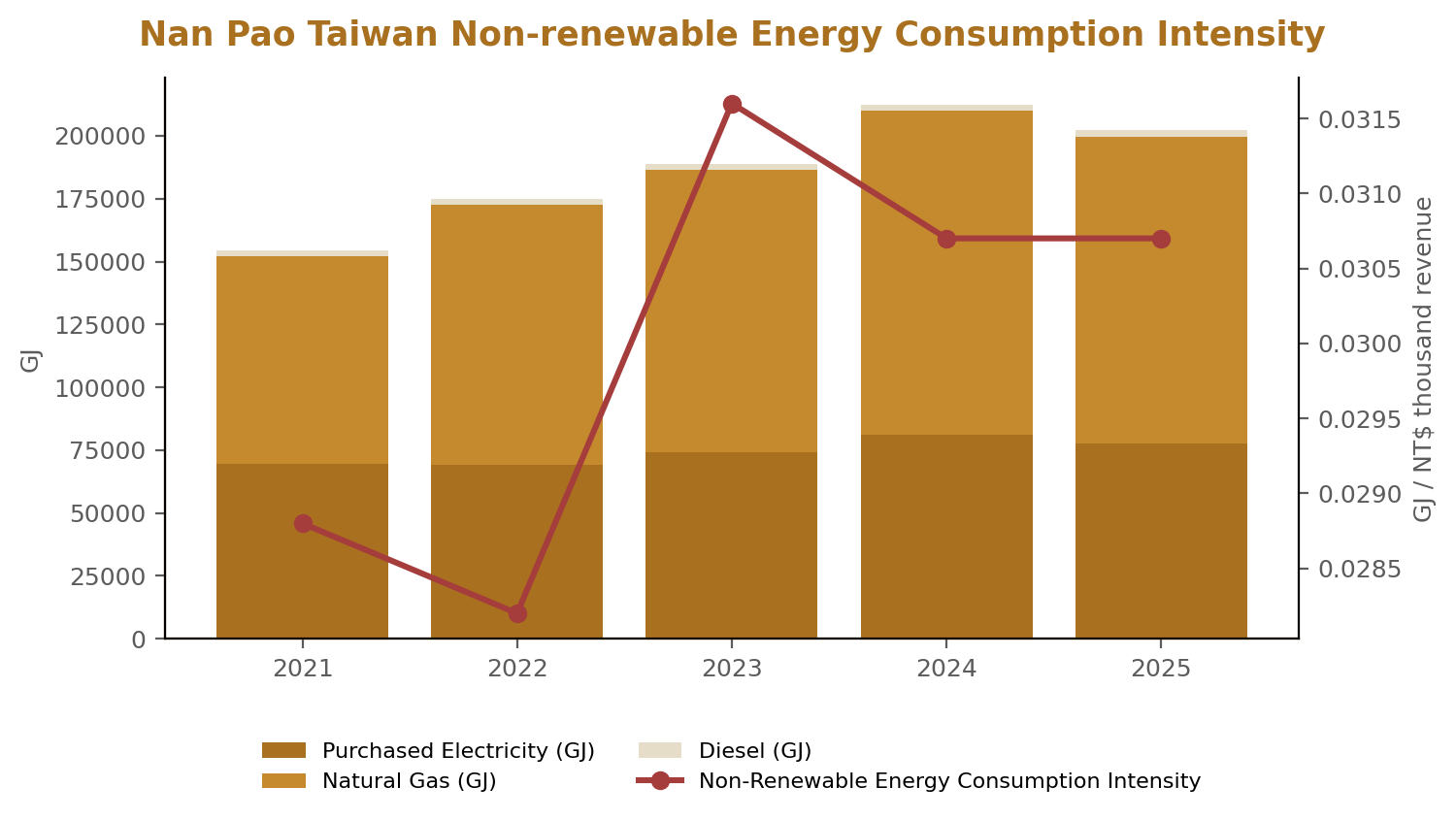
Nan Pao Taiwan Energy Use Ratio
| 2021 | 2022 | 2023 | 2024 | 2025 | |
|---|---|---|---|---|---|
| Purchased Electricity (GJ) | 69,736 | 69,283 | 74,255 | 81,077 | 77,597 |
| Natural Gas (GJ) | 82,261 | 103,288 | 112,161 | 128,734 | 121,942 |
| Diesel (GJ) | 2,508 | 2,454 | 2,418 | 2,580 | 2,665 |
| Total Non-Renewable Energy Consumption (GJ) | 154,505 | 175,025 | 188,834 | 212,391 | 202,204 |
| Renewable Energy (GJ) | – | 47 | 1,619 | 1,436 | 2,256 |
| Revenue (NT$ thousand) | 5,359,550 | 6,212,303 | 5,975,982 | 6,926,576 | 6,596,163 |
| Non-Renewable Energy Consumption Intensity (GJ/NT$ thousand revenue) | 0.0288 | 0.0282 | 0.0316 | 0.0307 | 0.0307 |
Note 1: Natural gas and diesel consumption for 2020–2023 have been recalculated in this reporting year using the unit heating values published for each respective year by the Energy Administration, Ministry of Economic Affairs, resulting in a difference in the calculation of non-renewable energy consumption intensity compared to prior periods.
In 2025, Nan Pao Taiwan's total non-renewable energy consumption was 202,204 GJ, an increase of approximately 7.1% from 188,834 GJ in the 2023 base year. However, revenue for the same period increased from NT$5,975,982 thousand to NT$6,596,163 thousand, representing growth of approximately 10.4%. Therefore, non-renewable energy consumption intensity decreased from 0.0316 GJ/NT$ thousand of revenue in 2023 to 0.0307 GJ/NT$ thousand of revenue in 2025, representing a decline of approximately 2.8% from the 2023 base year and indicating improved energy-use efficiency.
| 2022 | 2023 | 2024 | 2025 | |
|---|---|---|---|---|
| Purchased Electricity (Non-Renewable Energy) (GJ) | 116,790 | 129,007 | 148,673 | 144,320 |
| Natural Gas (GJ) | 144,437 | 150,761 | 168,425 | 158,804 |
| Diesel (GJ) | 24,352 | 21,621 | 28,085 | 31,124 |
| Total Consumption of Non-Renewable Energy (GJ) | 285,579 | 301,389 | 345,183 | 334,248 |
| Consumption of Self-Generated Renewable Energy (GJ) | 865 | 5,171 | 5,480 | 7,125 |
| Non-Renewable Energy Consumption Intensity (GJ/NT$ thousand revenue) | 0.0168 | 0.0198 | 0.0195 | 0.0196 |
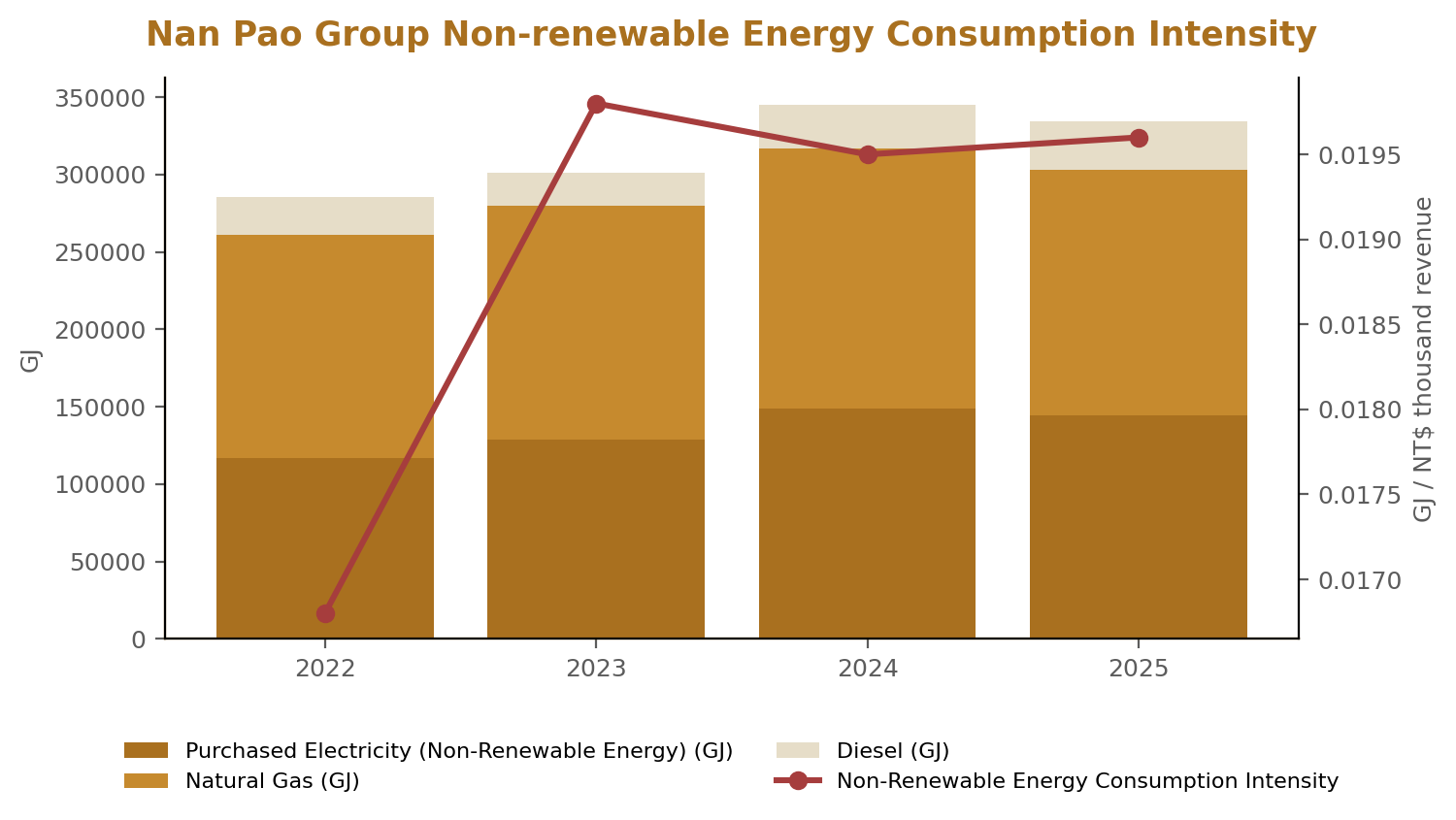
In 2025, the Nan Pao Group's non-renewable energy consumption was 334,248 GJ, an increase of 32,859 GJ from the 2023 base year. Non-renewable energy consumption intensity fell 1% from 2023, short of the target of a 5% reduction from the 2023 base year, mainly due to the expansion of the statistical scope, changes in output and product mix at certain sites, and increased demand for natural gas and purchased electricity. Although the target has not yet been achieved, Nan Pao has continued to promote improvement measures such as power stabilization, equipment efficiency enhancement, LED lighting replacement, electrification of diesel equipment, and renewable energy installation. In the future, it will strengthen the tracking of the actual benefits of energy-saving projects at each plant and continue to reduce the intensity of non-renewable energy consumption. For 2026, the Company plans a steady-progress strategy, with a target of reducing non-renewable energy consumption intensity by 5% from 2024.
To address fluctuations in non-renewable energy consumption intensity and the ongoing need for energy conservation and carbon reduction, the Group has actively invested in on-site renewable energy generation facilities since 2022 to reduce reliance on non-renewable energy. In 2025, the Group's renewable energy consumption increased by 1,714 GJ from the prior year, a growth of 30.83%. Going forward, the Group will continue to identify suitable plant sites for expanding renewable energy generation equipment, further increasing the proportion of renewable energy use, improving its energy mix, and reducing carbon emissions.
The Group conducted a root-cause analysis of the major gaps and planned subsequent improvement actions, as detailed below:
- The expansion of production capacity drove an increase in total electricity consumption, partially offsetting the improvement in energy intensity.
- Improvement of VOC-related equipment at Nan Pao Thailand was still under planning. In 2025, VOC emissions increased by 54.04% year over year, indicating that improvements in energy and process efficiency still need to be accelerated.
- The Group continued to promote equipment replacement and expansion of renewable energy, and the expected improvement in intensity for 2026–2027 was projected to rebound significantly.
2026 Continuous Improvement Plan
| Region/Company | Expected Completion Schedule | 2026 Key Initiatives |
|---|---|---|
| Nan Pao Taiwan | 2026–2027 phased implementation | Continued construction of the solar optoelectronics and energy storage system, the Baoli Plant and 5th Plant voltage stabilization system, secondary steam recycling, and replacement of diesel forklifts. |
| Foshan Nan Pao | Continued to be promoted in 2026, with some projects expected to be completed in July. | Addition of phase 3 solar power generation, RTO condensed waste solvent, and steam condensate recycling and reuse. |
| Foshan Goodwill | Execute in 2026 | Replacement of inefficient equipment, solar lighting, and condensate recycling. |
| Nan Pao Dongguan / Dongguan Jiaqin | Continuously implement in 2026 | Promote condensate solvent recycling and solar-powered supply for the circulating water pump house. |
| All plants in Vietnam | 2026 | Vietnam Nan Pao and Nan Pao Advanced Materials Vietnam: continued promoting the replacement of IE3 high-efficiency motors; Nan Pao Materials Viet Nam: introduced high-efficiency equipment; NNV: the proportion of electrified equipment continued to increase. |
Renewable Energy
Nan Pao regarded energy and GHG management as an important issue in daily operations and continued to promote energy saving and carbon reduction, improvements in energy efficiency, and the introduction of low-carbon energy. Based on the GHG inventory results, the Group's category 1 and category 2 emissions mainly came from purchased electricity and fuel use. Therefore, in addition to continuing to promote equipment efficiency improvements, process energy conservation, and energy management, the Company also coordinated with local governments' energy policies and promoted self-built, self-use solar power generation equipment at plants that had the necessary installation conditions, in order to gradually increase the proportion of renewable energy use and reduce operating carbon emissions.
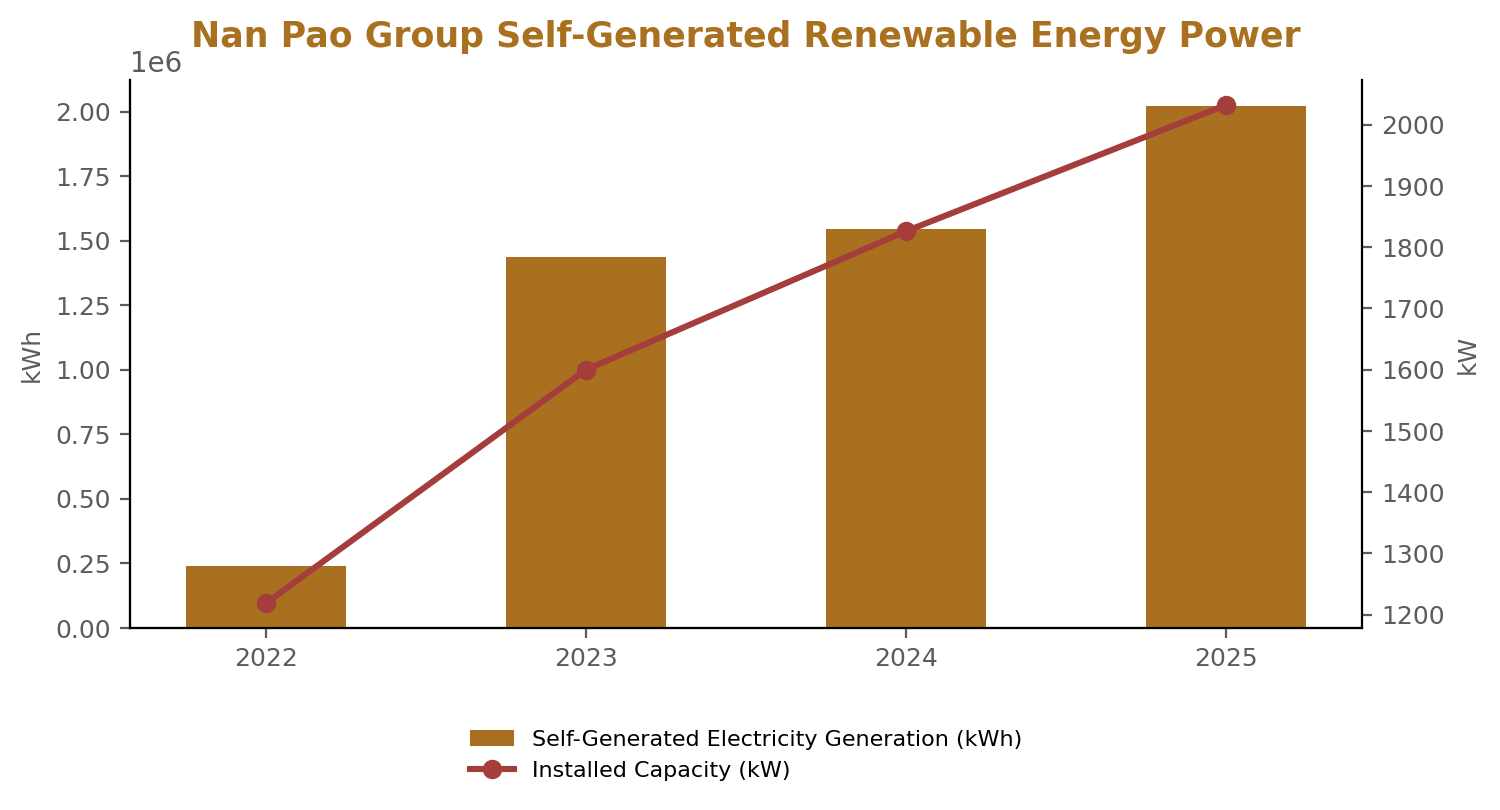
In 2025, Nan Pao Group's installed renewable energy capacity reached 2,032 kW, up 27% from 1,600 kW in 2023. Self-built, self-consumed renewable energy generation was 2,020,574 kWh, an increase of approximately 30.8% from 1,544,473 kWh in 2024, and approximately 40.6% from 1,437,387 kWh in 2023. Based on the 2025 electricity emissions factor estimates, self-built, self-used renewable energy generation over the full year could reduce CO₂e emissions by approximately 857 metric tons.
In addition to self-generated renewable energy for own use, Nan Pao also purchases renewable energy certificates (RECs) as appropriate, based on local operating conditions and customers' low-carbon supply chain requirements, as a management tool to supplement low-carbon energy use and respond to customer needs. In 2025, the Group obtained a cumulative 4,435,086 kWh of RECs, an increase of 3,001,086 kWh from 2024, mainly used to supplement renewable energy use and support customers' low-carbon supply chain needs.
To improve the consistency of renewable energy disclosures, Nan Pao will henceforth use "self-generation for own use" as the primary scope for managing renewable energy installed capacity and generation, with non-own-use feed-in or leased sites disclosed separately to avoid confusion with the Company's actual operational electricity use. The Company will continue to assess rooftop conditions, electricity demand, and installation feasibility at each plant, and advance toward a target of 2,500 kW of self-generation-for-own-use renewable energy capacity by 2030, progressively increasing the share of renewable energy and strengthening low-carbon energy management and carbon reduction results.
| 2022 | 2023 | 2024 | 2025 | |
|---|---|---|---|---|
| Self-Generated Electricity Generation (kWh) | 240,410 | 1,437,387 | 1,544,473 | 2,020,574 |
| Installed Capacity (kW) | 1,219 | 1,600 | 1,826 | 2,032 |
| Reduced Carbon Emissions (Metric Tons) | 119 | 710 | 732 | 857 |
Note 1: Self-generated renewable energy refers to renewable energy electricity actually used at the Company's operating sites, excluding generation from leased rooftops or electricity sold to the grid.
Note 2: Green electricity certificates/renewable energy certificates were reported separately from self-generated power, based on the actual amounts purchased or retired at each site, to avoid double counting.
Note 3: The amount of carbon reduction was estimated based on the applicable electricity emissions factor for the relevant year. For 2025, the factor used was 0.424 kg CO₂e/kWh; therefore, although power generation increased, the rate of carbon reduction growth
was affected by the decline in the emissions factor.