
Waste management
Nan Pao incorporated waste management into its key initiatives for environmental management and the promotion of the circular economy. In accordance with the regulatory requirements applicable at the locations of its operating sites, it carried out waste sorting, storage, labeling, reporting, collection, and treatment, and, based on the ISO 14001 Environmental Management System, identified waste types, quantities generated, and flow paths through regular waste inventories as the basis for continuous improvement.
Nan Pao commits to not using banned substances or materials and actively promotes waste reduction and recycling. In selecting raw materials and suppliers, the Company applies strict, careful management, continuously pursuing technical improvements or seeking environmentally friendly alternative materials. The Company also complies with environmental regulations and customer requirements related to its business and product/service offerings, striving to meet or exceed its established environmental targets.
.png)
In 2025, Nan Pao Taiwan's total waste disposal volume reached 1,801 metric tons, a decrease of 163 metric tons (8.30%) from the previous year. Waste disposal intensity was 0.273, down 3.9% from 2024.
.png)
In 2025, the Nan Pao Group's total waste disposal volume was 4,971 metric tons, a decrease of 459 metric tons (8.5%) from the previous year, and the Group's waste disposal intensity fell from 0.313 in 2024 to 0.298, indicating that total waste volume has been effectively controlled.
.png)
.png)
The Company's primary management strategies are "total waste reduction" and "waste resource recovery," working to reduce waste generation and increase recycling and reuse rates through source-level measures such as process technology optimization and reduced raw material use. In 2025, Nan Pao Taiwan made notable progress in waste resource recovery, with total waste recycled and reused reaching 754 metric tons, up 135 metric tons (21.81%) from 2023. Nan Pao Group's total waste recycled and reused in 2025 reached 1,327 metric tons, up 208 metric tons (18.59%) from 2023; of this, hazardous waste recycled and reused was 719 metric tons, with the recycling rate decreasing from 36.34% to 25.95%, while non-hazardous waste recycled and reused was 608 metric tons, with the recycling rate rising from 24.90% to 27.64%, indicating that waste management is gradually shifting toward resource recovery.
2026 Group Waste Management Target
| 2026 Group Target | The total amount of recycled and reused hazardous industrial waste increased by 5% compared with 2023. |
| 2023 Base Value | 729 metric tons |
| 2026 Target Value | Approximately 765 metric tons |
| Key Management | Expand channels for the reuse of hazardous waste, and strengthen solvent recycling, source separation, process waste reduction, and collaboration with suppliers/processors. |
| Expected Benefits | Enhance the resource recycling results for hazardous waste, reduce the final disposal volume, and strengthen group-level circular utilization management. |
Waste Disposal Breakdown — Nan Pao Group (metric tons)
| Non-Hazardous Waste | 2023 | 2024 | 2025 |
|---|---|---|---|
| Incinerated with energy recovery | 886 | 1,339 | 1,214 |
| Landfilled | 78 | 42 | 30 |
| Physical treatment | 2 | 5 | 3 |
| Thermal treatment | 195 | 238 | 260 |
| Biological treatment | 15 | 48 | 85 |
| Recycled / reused | 390 | 512 | 608 |
| Total | 1,566 | 2,184 | 2,200 |
| Hazardous Waste | 2023 | 2024 | 2025 |
|---|---|---|---|
| Incinerated with energy recovery | 963 | 1,945 | 1,564 |
| Landfilled | 84 | 62 | 38 |
| Physical treatment | 2 | 7 | 4 |
| Thermal treatment | 211 | 346 | 336 |
| Biological treatment | 17 | 69 | 110 |
| Recycled / reused | 729 | 817 | 719 |
| Total | 2,006 | 3,246 | 2,771 |
Waste Management Measures
| Management Aspect | Major Measures |
|---|---|
| Legal Compliance | Regular waste audits and legal waste clearance and disposal, reported to the competent authorities. |
| Source Reduction | Avoid the use of prohibited substances and raw materials; optimize processes to reduce waste generation at source. |
| Resource Recycling | Waste segregation and classified collection; expand recycling and reuse of hazardous and non-hazardous waste. |
| Objective Management | The total amount of recycled and reused hazardous industrial waste increased by 5% compared with 2023 (base 729 MT; 2026 target ≈765 MT). |
Solvent Recycling
The Company regarded solvent recycling and reuse as an important measure for promoting the circular economy and carbon reduction management. The Company introduced a waste solvent distillation recycling mechanism in the waterborne PU manufacturing process, and reused the waste solvent generated in the process after distillation and purification, returning it to the process for repeated use. Among them, acetone could be reused as a process feedstock; other recoverable chemicals generated after distillation recycling, such as butanone, could also be sold or reused in accordance with quality specifications, thereby enhancing resource utilization efficiency and reducing the need for raw material procurement and waste disposal.
In 2025, Nan Pao Taiwan produced 8,139 metric tons of mixed solvents during the manufacturing process. The mixed solvents could subsequently be processed and separated into solvents such as acetone and methyl ethyl ketone for reuse. However, because the quantities of the various solvents resulting from the subsequent reprocessing of mixed solvents in fiscal year 2025 has not yet been fully tallied, and in order to avoid duplicate counting or overstating the recycling and reuse performance, the output of such mixed solvents was not included for the time being in this year's solvent recycling statistical table and carbon reduction benefits estimation.
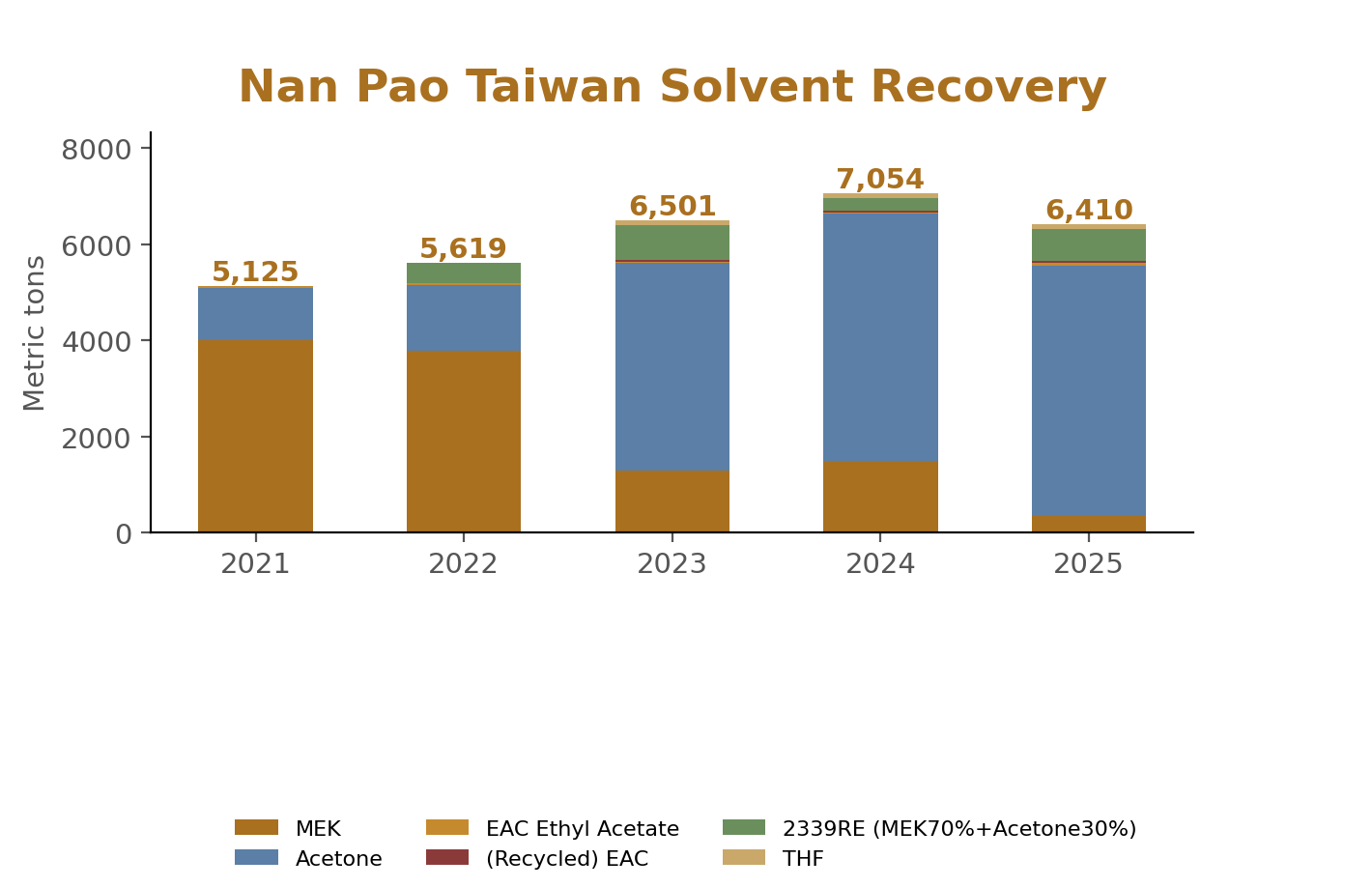
Excluding the output volume of the foregoing mixed solvents, the quantity of recovered solvents included in the statistics for Nan Pao Taiwan in 2025 was 6,410 metric tons, a decrease of 644 metric tons from 7,054 metric tons in 2024, representing a decline of approximately 9.13%. Although the annual volume included in the statistics for recycling decreased compared with the previous year, the Company continued to reduce the demand for newly purchased solvents and the burden of waste solvent treatment through process recycling and reuse. Subsequently, tracking of data on the separation, reuse, and sales of mixed solvents will be strengthened, and a more comprehensive performance management mechanism for solvent circular utilization will be established.
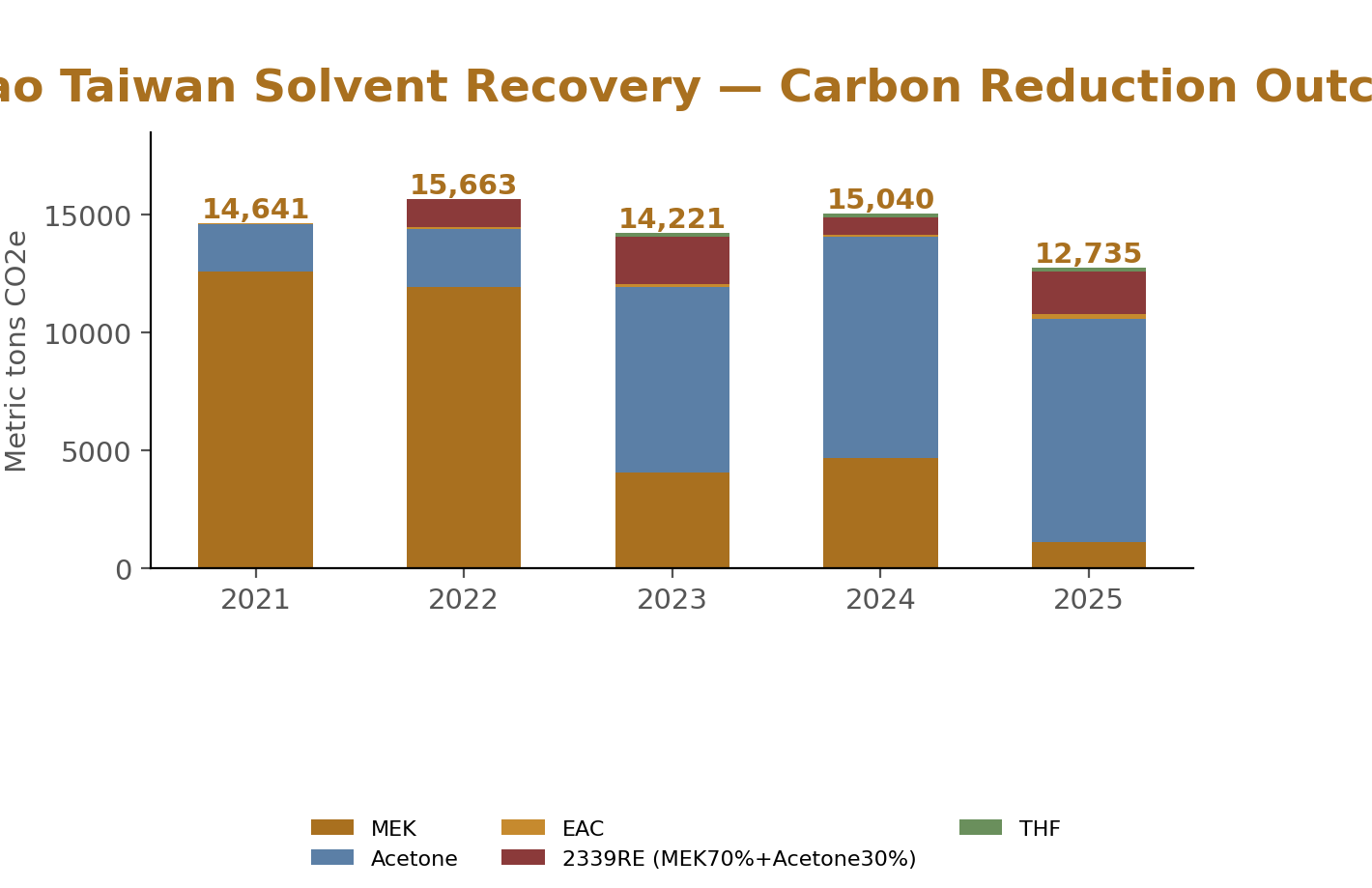
Based on the currently established emissions factors and quantifiable recycling items, the carbon reduction benefits of Nan Pao solvent recycling in Taiwan in 2025 were approximately 12,735 metric tons CO₂e. The carbon reduction benefits are attributable to avoided emissions generated from solvent recycling and reuse and were not used as a direct offset against the organization's greenhouse gas inventory emissions. In the future, the Company will continue to improve the management of the calculation boundary and coefficients for the types of recycling solvents, reuse volume, sales volume, and carbon reduction benefits, so as to enhance the completeness and comparability of the disclosure of circular economy responsibility performance.
| Nan Pao Taiwan Solvent Recovery (metric tons) | 2021 | 2022 | 2023 | 2024 | 2025 |
|---|---|---|---|---|---|
| MEK | 3,995 | 3,782 | 1,292 | 1,482 | 349 |
| Acetone | 1,100 | 1,362 | 4,317 | 5,151 | 5,203 |
| EAC Ethyl Acetate | 30 | 39 | 21 | 30 | 66 |
| (Recycled) EAC Ethyl Acetate | – | – | 41 | 26 |